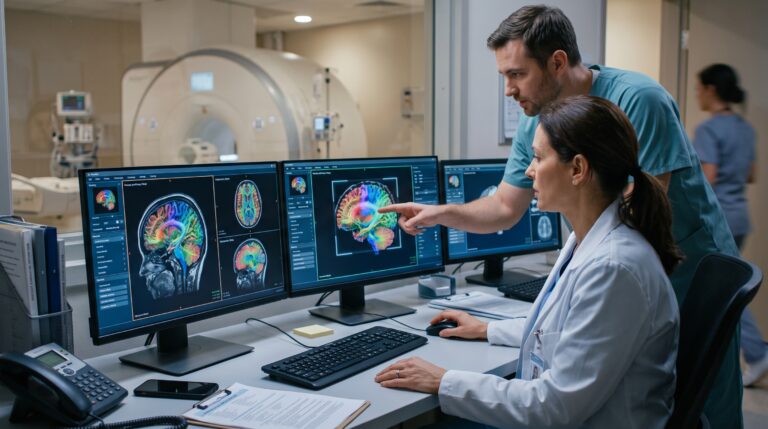
Artificial intelligence is rapidly transforming healthcare, and one of the most exciting areas of innovation is advanced brain imaging. Modern neuroscience no longer relies solely on traditional scans and manual interpretation. Today, AI-powered software systems help clinicians analyze neurological data faster, more accurately, and with greater detail than ever before.
From ADHD evaluations and cognitive assessments to traumatic brain injury analysis and neurological disease detection, artificial intelligence and neuroscience software imagery are improving how healthcare professionals understand the human brain.
At Applied Neuroscience INC. in St. Petersburg, Florida, advanced brain software imaging technologies support clinical neuroscience scans designed to provide deeper neurological insights and more personalized patient care.
Artificial intelligence (AI) in brain imaging refers to software systems that use:
to assist clinicians in evaluating neurological scans.
AI systems can analyze information collected from:
These technologies help clinicians identify neurological abnormalities that may be difficult to detect manually.
The human brain is extremely complex.
Modern brain scans generate enormous amounts of data that can be difficult and time-consuming to analyze using traditional methods alone.
AI helps improve:
This allows healthcare professionals to make more informed decisions faster.
Artificial intelligence can analyze neurological patterns with remarkable precision.
AI-powered neuroscience software imagery systems may help:
These technologies continue to evolve rapidly as machine learning systems gain access to larger neurological datasets.
MRI scans generate highly detailed images of brain structure.
AI-assisted MRI analysis can help clinicians:
This is particularly valuable in conditions involving:
AI may also help improve early detection of neurological conditions before symptoms become severe.
EEG and qEEG studies generate large amounts of functional brainwave data.
AI-assisted software imagery platforms can:
This is especially important in:
Patients searching for:
are increasingly interested in AI-assisted evaluations.
ADHD is one of the most common areas where AI-assisted neuroscience imaging is being explored.
AI may help identify:
Advanced software systems can analyze subtle neurological patterns that may not be immediately visible through traditional interpretation methods.
Although imaging alone does not diagnose ADHD, AI-assisted analysis may support more comprehensive clinical evaluations.
Brain software imagery acts as the foundation for AI-assisted neuroscience imaging.
These advanced platforms help:
Modern software tools are making neuroscience imaging more precise, visual, and data-driven.
Artificial intelligence also improves the creation and analysis of 3D brain imagery.
Three-dimensional visualization allows clinicians to:
AI-enhanced visualization improves both clinical interpretation and patient education.
Patients can better understand their neurological evaluations through interactive visual models.
One of the most advanced developments in neuroscience imaging is the integration of MRI and EEG data using AI-powered software systems.
MRI provides:
EEG provides:
AI systems can combine these datasets into comprehensive neurological models that improve:
This integrated approach is becoming increasingly valuable in advanced neurological care.
One of the most promising applications of AI in neuroscience is early disease detection.
AI-assisted systems may help identify subtle neurological changes associated with:
Earlier detection may allow:
Research in this area continues to expand rapidly.
Every patient’s brain is unique.
AI-assisted brain imaging may help clinicians personalize care based on:
This may support more individualized approaches to:
Personalized care strategies may improve treatment effectiveness over time.
Advanced neuroscience software imagery and AI-generated reports are increasingly used in medical legal services.
Objective imaging findings may support:
[Medical Legal Services –https://appliedneuroscienceinc.com/]
Detailed imaging analysis and visual reporting can improve clinical and legal documentation.
Although AI offers significant advantages, it is important to understand that it does not replace medical professionals.
AI systems still require:
Neurological imaging remains a collaborative process involving:
AI is designed to enhance clinical analysis—not replace it.
Patients throughout St. Petersburg and surrounding Florida communities are increasingly searching for:
Growing awareness around neurological health, cognitive performance, and personalized medicine is increasing demand for AI-assisted imaging technologies.
The future of AI in neuroscience is expected to include:
As technology evolves, AI-assisted imaging will likely become an even more important part of neurological healthcare.
No. AI assists clinicians by improving data analysis and imaging interpretation, but medical professionals still make final diagnostic decisions.
AI-assisted imaging may identify neurological patterns associated with ADHD, but clinical diagnosis still relies on comprehensive evaluations.
Brain software imagery refers to advanced digital platforms used to analyze and visualize neurological imaging data.
Yes. AI itself is software-based analysis. The imaging technologies it supports, such as MRI and EEG, are generally safe and non-invasive.
AI may improve diagnostic speed, pattern recognition, visualization quality, and personalized treatment planning.
Applied Neuroscience INC. provides advanced neuroscience imaging services in St. Petersburg, Florida.
Services include:
The organization combines advanced neuroscience technologies with exceptional customer service to support comprehensive neurological evaluations.
[Applied Neuroscience INC. – https://appliedneuroscienceinc.com/]
If you are looking for advanced AI-assisted brain imaging services in St. Petersburg, FL, Applied Neuroscience INC. offers comprehensive neuroscience imaging solutions designed to support accurate neurological evaluations and personalized care.
Contact Applied Neuroscience INC. today to learn more about:
Serving St. Petersburg and surrounding Florida communities.